
Content
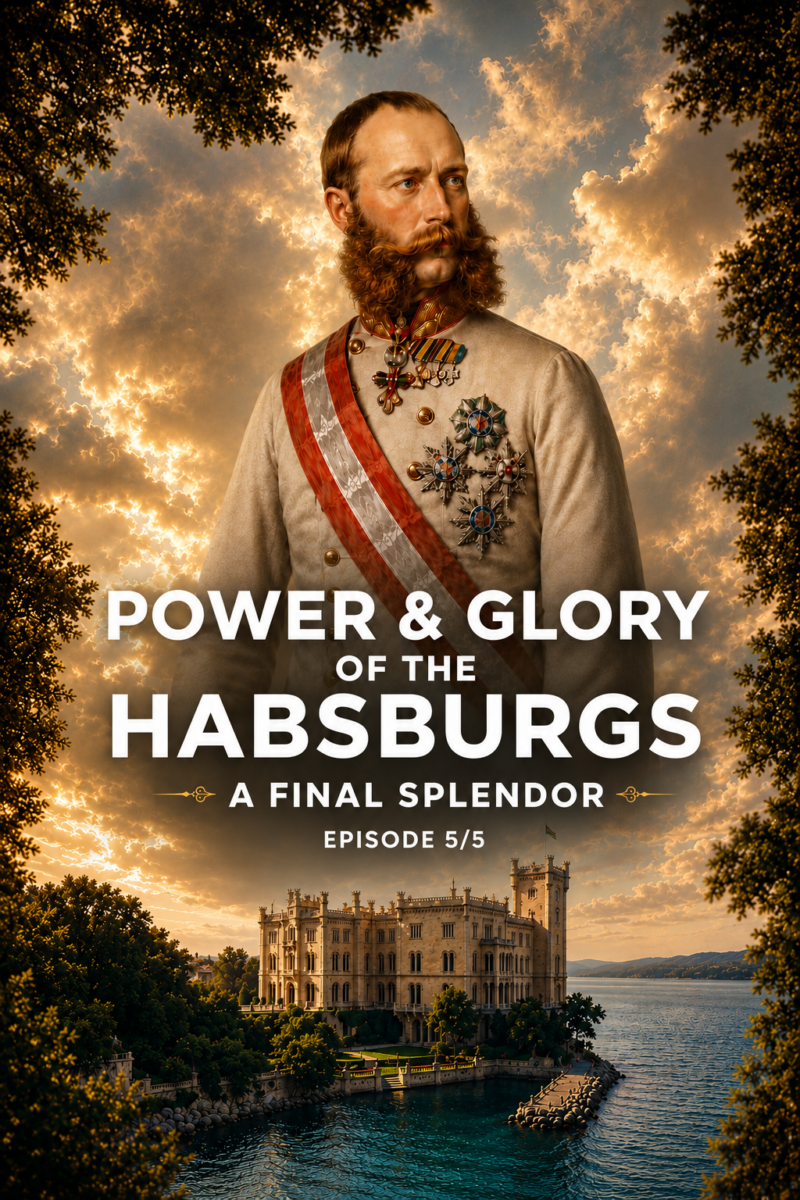
The fifth installment of the documentary series “Power & Glory of the Habsburgs” explores the era of the Austrian Empire and the resulting Austro-Hungarian Dual Monarchy. Vienna developed into an imperial metropolis, and numerous towns took on their own distinctive, typically Habsburg character.
The 19th century was marked by momentous changes. The Austrian Empire emerged from the Napoleonic Wars as a major European power. The railroad connected even the most remote corners of the multi-ethnic empire, and many cities were expanded in the characteristic Austro-Hungarian style.
This documentary highlights the changes that shook Europe—and with it, the Habsburg Empire—and presented the ruling house with enormous challenges. It covers a wide range of topics, from the reorganization of Europe following the Congress of Vienna and the Revolution of 1848, through the conflict between the major German powers of Austria and Prussia, to the expansion of the railroad and the question of nationalities. The final part of the series “The Habsburgs in Europe” is also a journey through the ages and to the most important locations associated with the Habsburgs and their eventful history.
Four Austrian emperors shaped the destiny of the monarchy from its founding until the end of Habsburg rule in Europe following World War I in 1918. The film explores how the Austrian emperors Franz I, Ferdinand I, Franz Joseph I, and finally Karl I responded to the challenges of their time. Wars against Italy, Prussia, and in the Balkans shook the empire, which at the same time was developing into a modern, magnificent state. Medieval Vienna transformed into a vibrant cosmopolitan city; the Hofburg was expanded in imperial style; and the magnificent Ringstrasse, with its palaces, was built. Cities such as Budapest and Trieste, too, soon shone with new, imperial splendor.
Along the new railroad line, elegant spa and summer resorts such as Pörtschach on Lake Wörthersee and Abbazia (Opatija) on the Adriatic Sea spring up. This is where the Habsburg Empire’s elite gather. But the cinematic journey also takes us to the Habsburgs’ most significant and beloved residences—to castles that shine one last time in imperial splendor or are even being rebuilt. From Miramare Castle near Trieste, the journey continues to Bohemia, where Brandeis Castle ranks among the Habsburgs’ most important residences. At the Imperial Villa in Bad Ischl, Emperor Franz Joseph’s great-great-grandson, Valentin Habsburg-Lothringen, recounts the happy days Franz Joseph spent here and leads visitors into the study where the emperor signed the declaration of war against Serbia in 1914. At Artstetten Castle in Lower Austria, Alix de La Poëze d’Harambure-Fraye guides visitors through the private quarters of her great-great-grandfather, Crown Prince Franz Ferdinand, whose assassination in Sarajevo ultimately led to the outbreak of World War I and the end of the Habsburg Monarchy.
Production data