
Content
The so-called Burgundian Wedding between the Holy Roman Emperor Maximilian I and Mary of Burgundy laid the foundation for an empire that spanned vast territories around the globe.
The Habsburgs’ successful marriage strategy in the 15th century led to the division of the House of Austria into a Spanish and a German line, which jointly ruled over an empire of which Emperor Charles V said that the sun never set upon it.
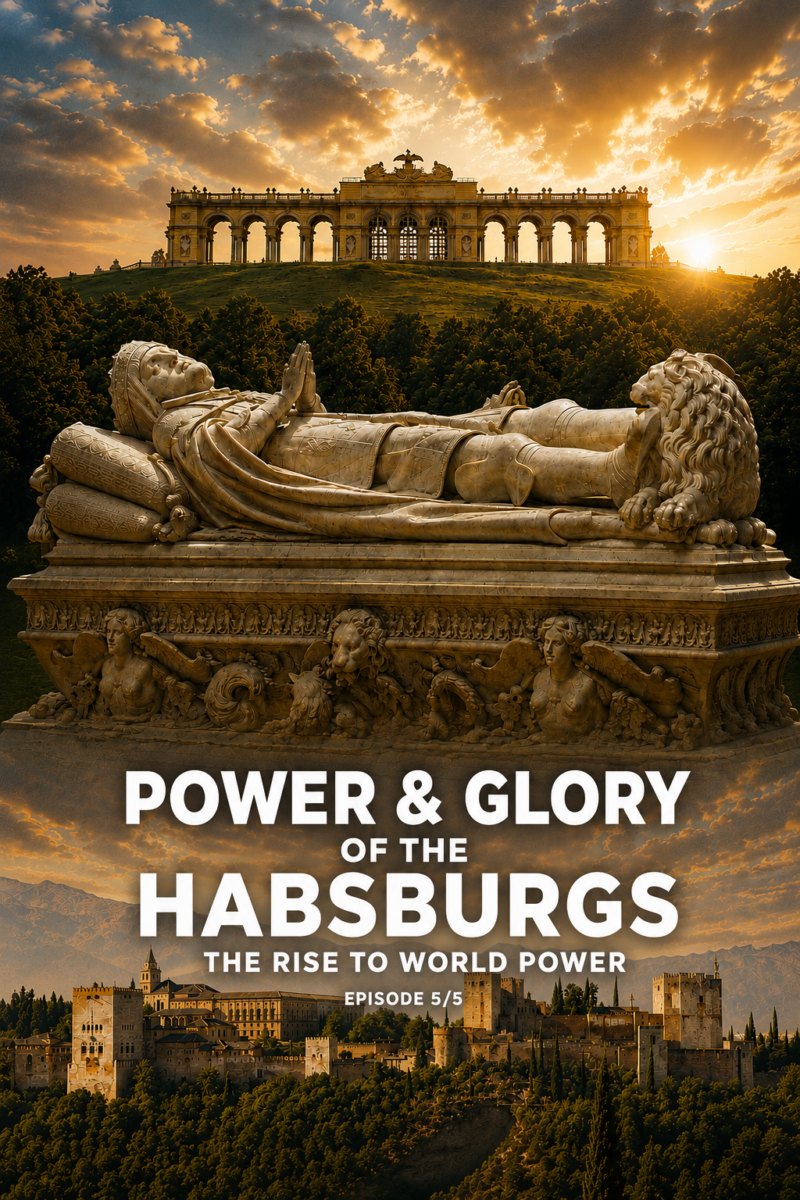
Episode 3 of the TV series “Power & Glory of the Habsburgs” focuses on the geopolitical consequences of the Burgundian marriage and the strategically significant marriages of Maximilian’s children, Margaret of Austria and Philip the Handsome, to the children of the Spanish monarchs Ferdinand of Aragon and Joanna of Castile. The two sons of Philip the Handsome and Joanna of Castile would later be elected Holy Roman Emperors: Charles V and Ferdinand I. As Holy Roman Emperor and King of Spain, Charles V traveled extensively, both within the Empire and in Spain. The film follows in his footsteps from Madrid through Toledo to Granada, where Arab architecture and the Italian Renaissance complement each other impressively in the Alhambra. Another stop is the monastery of Yuste in western Spain. Frustrated by the developments of his time and gravely ill, Charles had chosen this remote location to end his life.
A detour also takes us to Segovia, where Charles’s son, King Philip II of Spain, had a mint built around the middle of the century with the help of experts from Tyrol. Some of the gold and silver from the Spanish viceroyalties in the New World was unloaded at the port of Seville and minted into coins in Segovia. The gigantic monastery complex of El Escorial, which Philip II had built, is also impressive.
The film also follows British Habsburg expert and author Simon Winder on his journey through Austria. His search for clues first takes him to the House, Court, and State Archives, where the most important documents on the history of the Habsburgs are preserved. The journey continues to the Armory in Graz, home to the world’s largest collection of historical weapons from the 16th century.
The era of the religious wars and denominational divisions is also evident in the example of the Khevenhüller family in Carinthia. Karl Khevenhüller, lord of Hochosterwitz Castle, gives Simon Winder a tour of the impressive castle and tells him about his ancestor, Hans Khevenhüller, who served as the Holy Roman Emperor’s ambassador to the Spanish court and was a friend of Philip II. In Madrid, Karl Khevenhüller takes us to his ancestor’s grave and through the vast monastery complex of El Escorial, where Hans Khevenhüller spent a great deal of time with the king.
Production data